Saturday, July 31, 2010

Lake Gilles Conservation Park

Maryann and I are in Whyalla this weekend, visiting Maryann's daughter. They spent today doing "girlie" things, so I took off and did some birding. First stop was the Whyalla - Iron Knob Road looking for Thick-billed Grasswren again. I started a few kilometres closer than last time, and almost immediately saw one scuttle across the path in front of me. A little "pishing" and up he popped for a moment. I managed a couple of shots, but the light was poor so no keepers. A few hundred metres further on and another one called, this time on the better side of the track light wise. This continued over the next hour or so, and in the end I probably saw about a dozen birds in all. This one was the most cooperative, happily posing and singing for a couple of minutes. As I approached Iron Knob, I noticed a few pipits by the road, so did a quick U-turn, and almost ran over a Brown Songlark. He flew up and started his lovely song flight almost overhead. He is not yet in breeding plumage, and in summer he will be a lovely deep brown all over. My main destination for the day was Lake Gilles Conservation Park, near Kimba in the northern Eyre Peninsular. The lake has always been dry since I have been in Australia, and I had heard that it now has some water in it. It did, though it was nowhere close to being full. The conservation park is old growth mallee habitat with some Bluebush and some spinifex in the understorey. It is well know to birders as it the furthest east that a number of western specialities breed. I was hoping to snap a couple of these, Rufous Treecreeper (I have not seen one in South Australia) and Blue-breasted Fairywren (only seen fleetingly once before). I heard the treecreeper, but didn't get a sniff of the fairywren. I did see Jacky Winter and Golden Whistler though.

Friday, July 30, 2010

Thursday, July 29, 2010

Four Pigs, Three Balls and a Thong

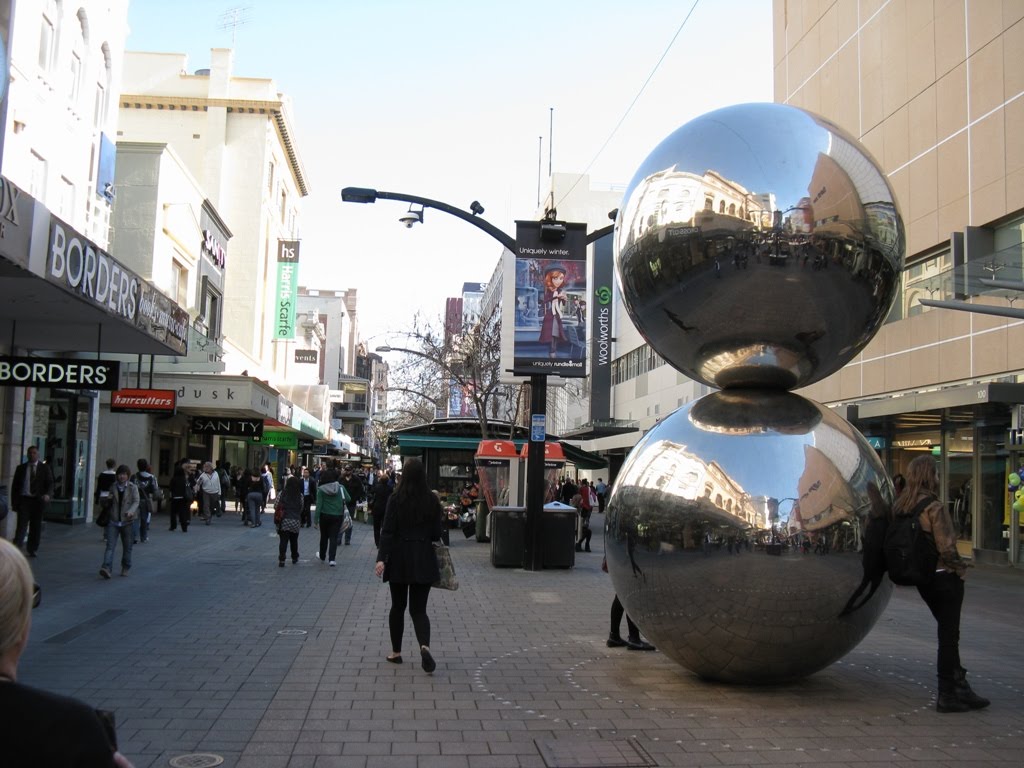
The other day whilst walking through Adelaide's main shopping street, I was watching people enjoying some of the sculptures, and I realised how much we take for granted. So yesterday, I decided to take some photos and share them with you. Probably Rundle Mall's most famous and best loved residents are Horatio, Truffles, Augusta and Oliver, our four life-sized pigs. They have amused countless people, young and old, ever since they were installed. Further down the mall you come to this little girl having great fun on the slide. And then there are the Spheres, at over 4 metres (13 feet) tall the largest sculpture in the mall. Colloquially known as "the mall's balls" it is a common meeting point. Just around the corner from Rundle Mall is Hindmarsh Square. The north-western corner has recently been re-developed into a community space filled with sculptures designed to be played on by children. I have not been able to determine the meanings behind them, but they all have a connection with South Australia. They are a tap and hosepipe A fish and a bone A clothes peg and a thong and a beach ball. Throughout the space there are some tall curved structures - I am not sure what these are, but they have prompted some people to nickname the area the elephant's graveyard. I hope you enjoyed this quick tour through the centre of Adelaide.

Sunday, July 25, 2010

Cobbler Creek Recreation Park

A combination of work, weather and illness has kept me from posting recently, but this morning I managed to get out for a couple of hours. The rail line into the city has been closed for a few weeks so I am taking the bus into work. The bus passes Cobbler Creek Recreation Park, a place I had never been to. It is only ten minutes from home, in the foothills of the Mount Lofty Ranges. It was a lovely crisp, frosty morning, and as I parked the car I was greeted by a pair of Australian Magpies "caroling". As I walked through the park, I noticed a local landmark popping up through the trees. Hollywood Plaza is my local shopping mall. It really shows off how much greenery there is in Adelaide. There were lots of parrots around the park, and many were prospecting nest holes. I didn't get shots of them all, but the Musk Lorikeets and Red-rumped Parrots allowed me close enough for some nice shots. On the way back to the car I heard some Striated Pardalotes calling so headed off the path and finally caught up with them in a eucalypt with a huge Ravens nest in it. Pardalotes are always confiding, and I got a good selection of shots. I couldn't decide between these two so I am including them both in the post. Finally a Monarch butterfly. This migrant is only common here in the winter, and always brightens up a winters day.

Friday, July 9, 2010

Skywatch Friday

Lone tree silhouetted against the dawn sky
Adelaide Hills, South Australia

Friday, July 2, 2010

Skywatch Friday

Lunar Eclipse, Adelaide, South Australia, 26th July 2010
Taken over a period of 3 hours.

Sunday, June 27, 2010

Tolderol and Pangarinda

Yesterday I decided to go and check out one of my favorite birding spots, Tolderol Game Reserve. This reserve is on the northern shore of Lake Alexandrina, which, until recently, has been dry for about 2 years. As Tolderol gets its water pumped from the lake, Tolderol had also completely dried out. The lake is now almost full again, (due to floodwater from Queensland flowing down the River Murray), and I was hoping for Tolderol to be wet again. To get there I headed over the Adelaide Hills and drove through a wonderful Sunrise. I stopped at Strathalbyn, normally a bustling town, but all was quiet just after dawn. This is a lovely little park in the centre of town, and it's resident Pacific Black Ducks were very quick to investigate me for any food!! Just outside "Strath" I noticed a movement in a tree, and a quick U-turn later I was watching a Black-faced Cuckoo-shrike. This is a fairly common bird in South Australia, but they are not very confiding. I still haven't got any good shots, and this one is the best of a bad bunch. On the way in to Tolderol, I passed a couple of feral camels. There is a large population of camels in Australia, mainly from escapes and releases from a time before railways criss-crossed Australia and people used camel trains to transport goods to and from outback towns. Unfortunately, Tolderol hadn't improved, and most of the reeds have died, but on the lake there was plenty of avian activity and there was a group of Whistling Kites and a lone Black-shouldered Kite at the picnic site on the lake shore. I had been hearing the calls of Golden-headed Cisticola and White-fronted Chat but not seen them, so I sat quietly and waited. As the sun came out a cisticola popped up and I manage a couple of shots whilst slowly stalking closer. I had no joy with the chat until I was on the way out and I surprised this male on a perch by the track. On the way home, I headed east towards Wellington, and saw this tree full of Galahs. Just over the river at Wellington is the Pangarinda Arboretum. This small arboretum is always a good spot, and this time there was a wonderful show of Banksias in flower.