We spent the long weekend relaxing in an isolated cottage overlooking the Inman Valley on the Fleurieu Peninsula.
We had a few birdy visitors to the garden, including a very inquisitive Little Wattlebird which spent most of it's time in the Banksia(?) next to our veranda.
There were many Superb Fairywrens, but unfortunately the males are in eclipse plumage with only the blue tail giving a hint at what's to come.
Each afternoon, the lawn played host to a flock of 6 Red-browed Finches
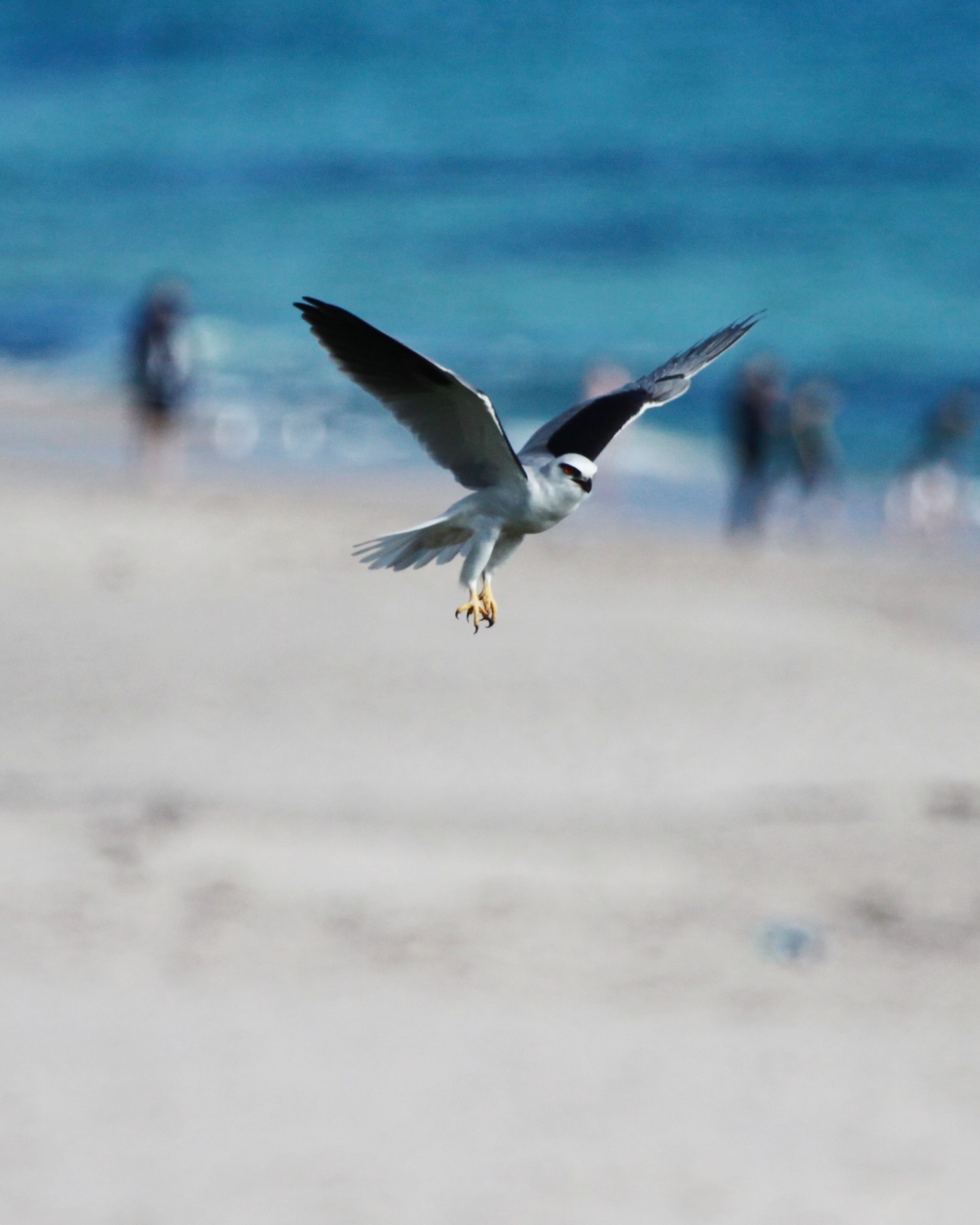
On Sunday we went to Carrickalinga, hoping to find a Hooded Plover or two, but no joy. We did watch this Black-shouldered Kite looking for lunch, and a Masked Lapwing on the roadside verge.
We had been seeing lots of Adelaide Rosellas, and on the last morning one came to the feeder. A cracking male of the fleurieuensis sub-species.
Showing posts with label Black-shouldered Kite. Show all posts
Tuesday, June 12, 2018
Tuesday, August 1, 2017
A day full of raptors
I spent this morning driving the back roads between Lower Light and Hamley Bridge looking for raptors.
Within 200m of Port Wakefield Road I saw the first of many Spotted Harriers. This one came and checked me out and at one point was too close to photograph.
In the same area were a pair of Black Kites, and one shot was photo-bombed by a Black-shouldered Kite which then thermaled with the other birds.
Other common birds were Australian Kestrel and Brown Falcon
Within 200m of Port Wakefield Road I saw the first of many Spotted Harriers. This one came and checked me out and at one point was too close to photograph.
In the same area were a pair of Black Kites, and one shot was photo-bombed by a Black-shouldered Kite which then thermaled with the other birds.
Other common birds were Australian Kestrel and Brown Falcon
Labels:
Black Kite,
Black-shouldered Kite,
Brown Falcon,
Kestrel,
Raptors,
Spotted Harrier
Saturday, May 15, 2010
Parrot Identification
Today I attended a workshop in Goolwa. On the way I spotted a raptor sitting in a pine tree. It was one of the more common Australian raptors, a Whistling Kite. Outside the church hall where the workshop was held was a large flowering eucalypt. It was full of New Holland Honeyeaters.
The workshop was hosted by the Department for Environment and Heritage, and concerned the critically endangered Orange-bellied Parrot. This parrot is on the verge of extinction with only 50 birds left in the wild (all of which breed at one site in Tasmania)and approximately 200 in captivity. The reintroduction of captive birds at a second site in Tasmania has been suspended as it was not successful. You can read more about the OBP here.
The workshop was held to help people identify OBP from the other three common similar species in the area, Elegant Parrot, Rock Parrot and Blue-winged Parrot in preparation for the first of three winter surveys.
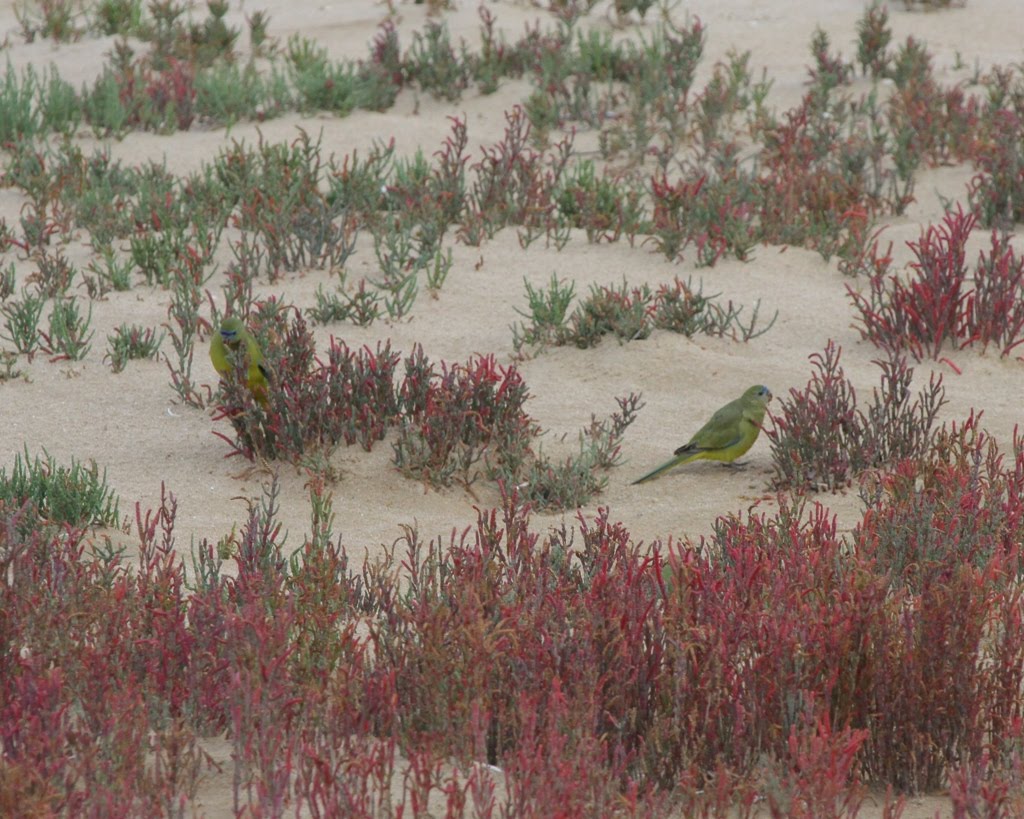
After the workshop, we all went to Hindmarsh Island to look for parrots. OBP has been recorded here in the past, but we were not expecting to see any and were not disappointed. Hindmarsh Island is at the northern end of the Coorong National Park, and the area we visited was an area of saltmarsh and Samphire.
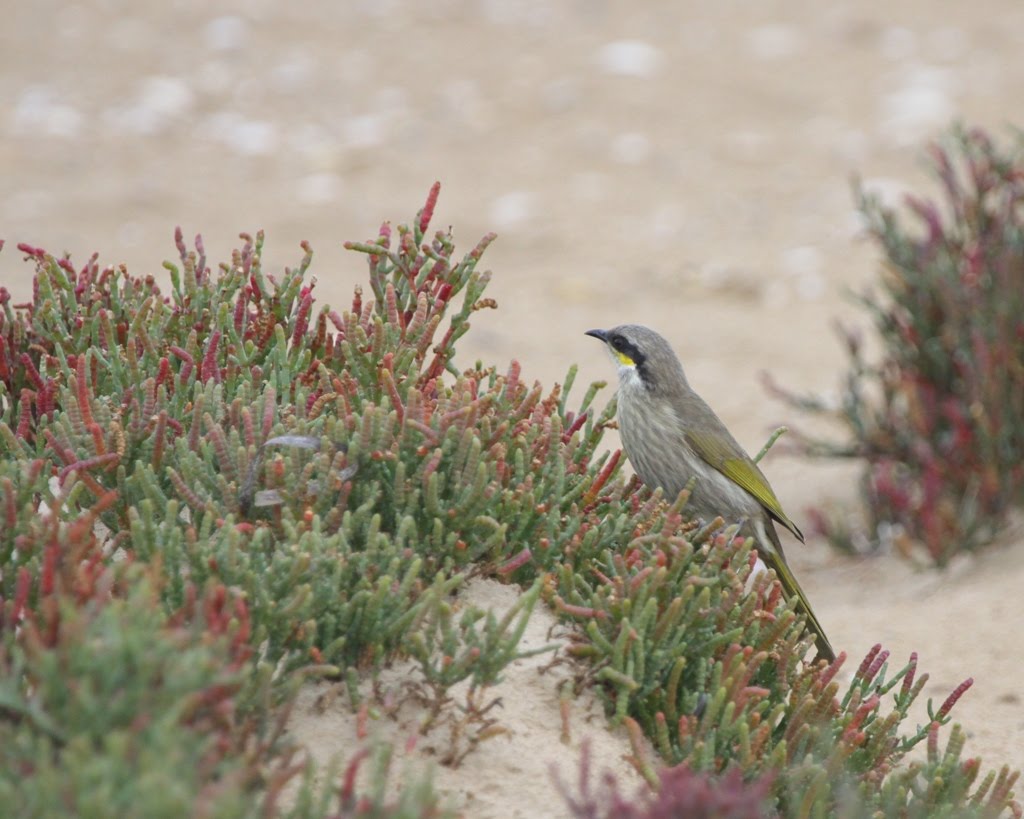
We found at least five Rock Parrots here, and I managed a few shots, but they are highly cropped, so apologies for the quality. There were also a few Singing Honeyeaters here.
A short distance away we also saw some Elegant Parrots. They were too far away to be photographed, so here is one I photographed a couple of years ago.
Finally, on the way home I spotted an Australian Black-shouldered Kite, and as I watched he caught some prey, which the female then took from him. I have not seen this behaviour in Black-shouldered Kites before.
Oh, when I said we didn't see an OBP, I was not quite telling the whole truth, as we did see one..............
Monday, October 5, 2009
In search of waterbirds
Following yesterday's virtually waterbirdless walk around my local wetland, I decided to head up into the hills to look for waterbirds. I headed towards the Barossa Valley, South Australia's most famous wine area, and home to the Jacob's Creek and Wolf Blass wineries. I was amazed at how the vines had come along since my last trip to the hills (3 weeks ago with Peter and Margaret from Scotland). Most of the vines have plenty of new growth with only a few of the late fruiting varieties still bare.
With all of the rain we've had this winter, there are plenty of marshy areas along the sides of the road and many of them have these lovely flowers in them. They look like a form of Iris to me. I have not seen them before, or at least not noticed them.
Also in full bloom at the moment is the Calistemon or Bottle-brush Tree. These are native Australian tees, but there also a lot of cultivated varieties available like this one. They are very popular with the honeyeaters and lorikeets, but this one was being visited by a Silvereye.
I was heading to the little town of Tanunda, where there is a nice group of pools (actually the local sewage works) that usually holds a good selection of ducks. As I was crossing Jacobs Creek (yes, it does exist, and no they don't use the water for making wine) I noticed a group of Black-tailed Native-hens on the edge of the vineyard. These nomadic gallinules and can turn up almost anywhere in large numbers.
The pools didn't disappoint. First on the list was Pink-eared Duck. This odd looking duck used to be known as Zebra Duck yet they chose to rename it after it's most inconspicuous fieldmark!! Also in the photo are Hardhead, Australian Little Grebeand Australian Shoveller. I didn't spot this one until I looked at the photos!!.
On the next pool were a two species of wader (shorebird), with both looking as if they may have been breeding there. The Red-kneed Dotterel tried the broken wing routine, and the Black-fronted Plovers had a juvenile bird with them.
Also here were half a dozen Blue-billed Ducks - a close relative to the Ruddy Duck of America and White-headed Duck of Europe. This was the first time I had seen them here. These guys are obviously very shy as they stayed on the far side of the pond for the whole time I was there, so the photo is very heavily cropped.
While I was watching the ducks, I had a strange feeling that I was being watched, and turned around slowly to find a Black-shouldered Kite hovering behind me - I managed to get a couple of shots in before he flew off.
On the way back home I spotted a small parrot on a fence wire, so slowed down and saw it was a Red-rumped Parrot. They are not usually very co-operative, but this one obviously hadn't read the manual!! He was quite happy to sit still for a couple of photos.
With all of the rain we've had this winter, there are plenty of marshy areas along the sides of the road and many of them have these lovely flowers in them. They look like a form of Iris to me. I have not seen them before, or at least not noticed them.
Monday, June 29, 2009
Black-shouldered Kite
Driving back and forth to Whyalla as I do, I cover many thousands of kilometers every year, and it is inevitable that a number of birds fall foul of this. A couple of months ago I sadly hit a Black-shouldered Kite, one of a pair that was hunting low over the verge. It was a glancing blow, and I hoped that the bird managed to survive the impact without serious injury. This week, at about the same spot, I again saw a pair of Kites. Hopefully it was the same pair.
As it was a nice evening and the light was still reasonable, I did a quick U-turn and tried a couple of shots.
When I first came to Australia five years ago it seemed that these lovely birds were everywhere, but over the past couple of years they appear to be declining. These shots were mainly taken in 2005, the first was digiscoped with my Kowa 823 and Nikon 995 combo.
Subscribe to:
Comments (Atom)