Monday, November 9, 2009
Spring heatwave and dolphins
We are in the middle of the first ever November heatwave (officially 5 consecutive days over 35C = 95F) in Adelaide, and this does not bode well for the water situation here. As I passed by, I estimated that the pink lake at Lochiel receded by almost 1 metre (3 feet) between Friday and Sunday this week.
Also on my way to Whyalla I decided to take a closer look at one of the wind farms that has sprung up along a range of hills in the north of the Yorke Peninsular. South Australia does not have any nuclear power stations, relying on coal and more recently gas fired power stations. For renewable anergy sources, as well as windfarms, homes and factories are being encouraged, by generous grants, to install solar power, and if they make a surfeit they can sell it back to the power companies.
On Saturday we took a short stroll around the marina and along the beach and saw all of the usual things. As usual, the local pod of dolphins were accompanying each returning fishing boat right up to the pontoon. (Much to the joy of visitors and locals alike.)
Along the beach were plenty of Silver gulls, including this engaging youngster who posed for me. Further along were is bigger relatives the Pacific Gull represented by an adult and a bird almost moulted into its adult plumage.
Sunday morning we headed out for another go at the Grasswrens, but didn't see. let alone photograph any. However, we did see plenty of Bluebonnets and Southern Whitefaces. Oh well, there is always next time!!
Wednesday, November 4, 2009
Spring Evening at Kaurna Wetlands Park
After a stressful day at work yesterday, it was turning into a lovely evening as I walked home through the local wetlands. So I decided to grab my camera and see what I could find. I am so lucky to have this wetland park right on my doorstep. It is certainly becoming my "local patch" and I also tend to think of it as an extension to my garden (yard).
The southern and eastern tracks were very quiet, a few wattlebirds and honeyeaters in the trees, and unusually, no lorikeets. I did notice there were fewer flowering eucalypts so they have probably moved on to find new sources of nectar.
The northern end opens out into the wetland proper, and it was brimming with life!!.
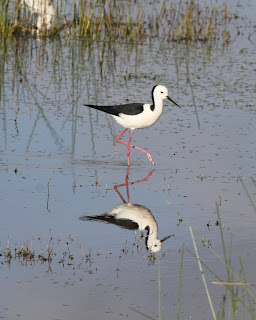
At one spot close to the path there were two Royal Spoonbills (only the second group I have seen here), some White-faced Herons, Great Egrets and a very smart White-headed Stilt.
Using trees for cover, I slowly inched forward and got into position for a nice close-up of the Spoonbills, only to have them spooked by a family out with their dog. I did get a couple of nice flight shots so it wasn't all bad.
After dinner, I noticed light streaming through a window at home. It was this wonderful full moon. I must try and get some photos of the moon in other phases.........hmm I can feel another post coming on.........
As I carried on towards home I unwittingly disturbed a young Pacific Black Duck family. On the last pool were a couple of Black-tailed Nativehens. Due to the good winter rains this year, these birds are in plague proportions around Adelaide at the moment.
Monday, November 2, 2009
Arid Country and a Grasswren
I headed back up to Whyalla this weekend, having not been there for over for a month. The land is very dry again, despite the good rains this winter. There are lots of flowers out though. These pink ones are plentiful along the roadside.
We headed up to the lookout on Friday evening to try and catch a bit of breeze and watch the sunset. We missed the sunset by a few minutes, but the view was still good. I then went to the marina to try out a new setting I had found on my camera that extends the maximum ISO from 3200 to 6400 or 12800. I wish I knew about this when I was in the rainforest in Queensland!!
On Saturday morning I headed out early to try and photograph Thick-billed Grasswren. Grasswrens are a lovely group of birds, generally confined to arid land. Then tend to skulk in cover, dashing from bush to bush giving short glimpses. I have seen various species of Grasswren but never managed a shot of one. I had just been told of a small population close to Maryann's home and it seemed an ideal opportunity to get familiar with it. The area they inhabit near Whyalla is an area of small sandhills and Saltbush/ Bluebush scrub between a road and a railway track. I slowly drove along looking for any sign of movement. Twice I saw one run across the road and disappear. So I stopped at a likely looking place, and tried my Audobon Bird Call. Up popped a couple of White-winged Fairywrens - no photo, and then a Grasswren, Click! and gone!! This is the highly cropped and magnified result - It is definitely the rear view of a Grasswren. Next time I am over I will give it another go and try to get his good side!!
I also saw some interesting tracks in the sand made by a large lizard. I followed the tracks, but couldn't find it anywhere. They were probably made by a Sand Goanna.
Going back through Whyalla, I noticed this unusual tree with its even more unusual fruit/nut/seed pod.
Finally on the way home to Adelaide I passed the ephemeral salt lake at Lochiel which had turned a lovely shade of pink! This is due to carotene being released by the algae Dunadiella Salina
Thursday, October 22, 2009
The Art of Nature
At work, we are currently running a photographic competition open to all residents in South Australia. The photos must have been taken in South Australia, and the top 12 photos will be used in a calendar. Unfortunately, employees of our department (Department for Environment and Heritage) are not allowed to enter the main competition, but there is an employees competition to provide the photo for the front cover of the calendar.
I have entered a few of my photos, some of which have appeared previously in my blog and some which haven't. The winners will be decided by public voting, and voting is open to any Australian resident. This is the link to the competition website and here are the photos I entered.
Coorong National Park
Sturt's Desert Pea
Innes National Park
Rainbow Lorikeet
Eastern Spinebill
Koala
Rainbow Lorikeets
Dalhousie Homestead
Australian Pelicans
Yellow-footed Rock Wallaby
Tawny Frogmouths
Yellow-footed Rock Wallaby
Sunday, October 11, 2009
St Kilda Saltfields
Late last year, one of Adelaide premier birding spots was closed to birders. This was due to the misuse of access by some people, and the owners decided to completely review their policy of allowing birders to have access.
I am happy to say that they have now reopened the Saltfields to birders. Access is controlled by Birds SA, the South Australian affiliate to Birdlife International. Access is only granted once you have participated in an induction. You must also be a member of Birds SA if you are local, or a another recognised birding organisation if you are an interstate or international visitor.
The saltfields are only 5 minutes drive from home, and yesterday I decided to visit for the first time this summer. Some migrants have started to arrive, and were evident almost as soon as I entered the site. The first group of waders (shorebirds) was a flock of about 250 Red-necked Stints - none of which showed any red as they were all either in fresh winter or juvenile plumages.
As I made my way along the tracks I noticed a few pairs of Australian Shelducks - quite content if I kept on the move, but as soon as I stopped off they would go!! The female (separated by the white eye-ring) is in flight, and the male followed a split second later!!
About halfway round is an area with a lot of dead trees, that has been taken over by 1000's of Little Black Cormorants as a roosting site. You always know if you are the first person past that day as they all fly off as the first car passes.
Further on I saw a few Sharp-tailed Sandpipers. Along with the stints seen earlier, these are our most numerous summer visitors and can number many tens of thousands at the height of summer.
All around the saltfields Whiskered Terns could be seen swooping down picking insects off the waters surface. I had 50 or so attempts at a decent flight shot, but finally gave in, so you'll have to make do with this perched shot!!
A very common resident is Masked Lapwing, and they can be very intimidating if you get too close to their nests or young. This one was happy to just watch me as I passed.
During the couple of hours I was at the saltfields I saw around half a dozen Shingleback Lizards. These are among the most common lizards in South Australia and barely a day out will pass in the summer without seeing one or two.
Saturday, October 10, 2009
Adelaide Parklands - Himeji Garden
Yesterday I went to a good friend's wedding at the Himeji Garden in the Adelaide Parkland. Adelaide city centre is surrounded by a belt of parkland, some laid as formal gardens, some left as informal, and some set over to sporting fields. The Himeji Garden is a formal Japanese walled garden that was laid to commemorate the twinning of Adelaide with the ancient city of Himeji in 1982.
It was the first time I had been to the garden and it is a wonderfully quiet place with lots to look at. The main features are a small lake and a "Sea of Sand".
There are lots of flowering plants around the gardens including many different coloured Irises.
Birds were flying around everywhere, and by the lake was a White-faced Heron. Under the verandah by the "Sea of Sand" was a small family of Welcome Swallows.
Finally, I'd like to congratulate Kylie and Adam once more, and wish them well for their future together.
Subscribe to:
Posts (Atom)