Monday, June 21, 2010

Little Para Linear Park

In between showers on Sunday I visited another local wetland at White's Road. It is part of the Little Para Linear Park, which follows the course of the Little Para River. Whites Road Wetland sits between the evaporation Ponds and the production area of the local saltfields and is in a fertile area used for agriculture and also horse breeding and training (due to it's close proximity to Globe Derby Trotting Track). As I started birding, I could have been fooled into thinking I was back in England!! My first birds of the day where all immigrants like me!! Greenfinch, Goldfinch and House Sparrow, along with calling Starlings and Blackbirds. These were all seen around one of the access gates to the Saltworks, so the setting is not particularly aesthetic. There were some locals here as well, with Singing Honeyeater enjoying the sunshine, and Welcome Swallows hawking for insects and taking a breather on the fence. Then I moved on to the wetlands where I walked along a path that is the closest we get to an english country lane. With all the rain, there is plenty of standing water so the lake wasn't as packed with birds as it usually is. The ground is covered with an invasive weed (Soursob) at the moment, and they are just beginning to flower. The bees were busy collecting pollen and you can see the pollen on the back legs of this one. This noisy Red Wattlebird caught my attention proudly showing its yellow belly, and when I got back to the car, I was very soundly told off by Willie Wagtail for parking too close to a favoured perch!! Whilst I was walking I kept hearing the lovely flutey song of a Grey Shrike-thrush, and I thought I had spotted him in an old Casuarina, but it was a Spotted Dove (another immigrant - but from Asia this time). Finally I caught up with him, as I whistled a poor imitation of his song, and he popped up to see who was answering him.

Tuesday, June 15, 2010

Winter - Kaurna Wetlands Park

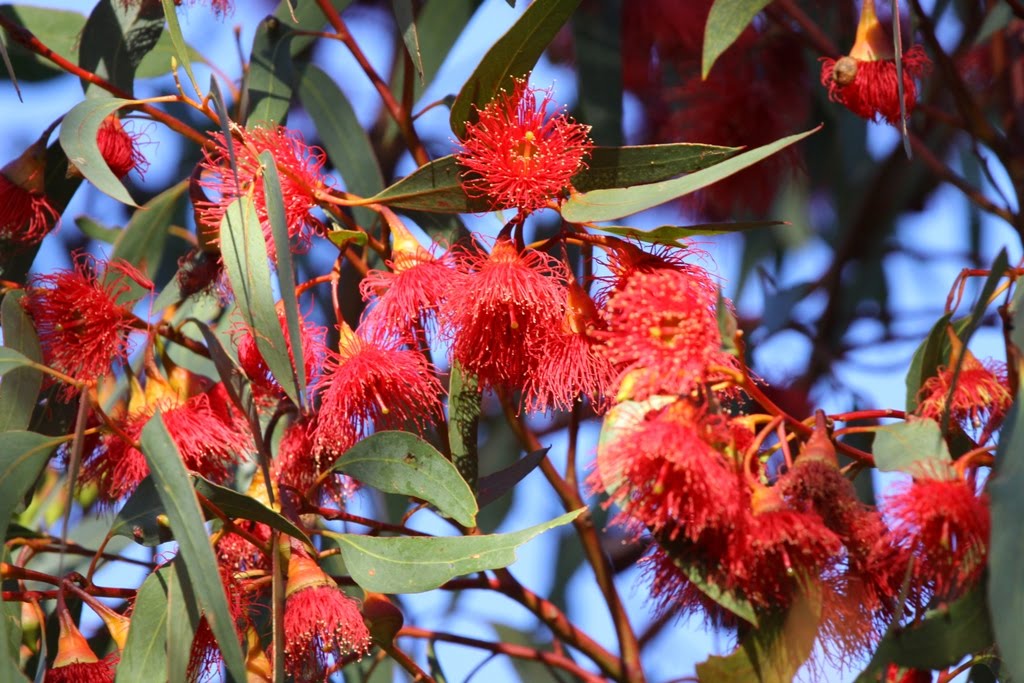
We've had some reasonable rain this autumn, so I decided to have a quick walk around "my" wetlands to see how they were progressing. Most of the channels had some water in them, but the wetland area is still dry and looking very lush and green. The eastern stormwater pond was almost full, and had a Little Pied Cormorant, a White-faced Heron and a couple of Pacific Black Duck's in attendance. It wasn't until I got to the northern path that I began to see some flowering Eucalypts. There seemed to be three different types in bloom with red, yellow and apricot coloured flowers respectively. The Red Wattlebirds seemed to prefer the red flowers. The White-plumed Honeyeaters spent most time in the yellow flowering trees. And, as usual, the New-holland Honeyeaters were absolutely everywhere!!

Monday, June 14, 2010

Monarto Zoo

Yesterday we visited Monarto Zoo. Monarto is about 40 minutes drive South East of Adelaide, and is an open zoo. It is spread over a large area and there are buses that take you through some of the exhibits. There are also walking trails here. It is built on the site of an old cattle station, so much of the land had been cleared, but the zoo is making efforts to return muck of the land to it's original state. Out first stop was to see Yellow-footed Rock Wallabies. I have seen these a few times in captivity, and though looking for them a few times in the Flinders Ranges, have yet to see them in the wild. It was not until I looked at the photos that I noticed the size of their feet!! They certainly live up to their family name of macropods!! At the back of the wallaby exhibit were a noisy group of White-winged Chough. I am still waiting to get a decent shot of this common Adelaide hills resident. We then visited the Chimpanzees. At the moment Monarto has four young males, but four females from Amsterdam Zoo are due to arrive soon, and they are hoping to begin a breeding program here. Then we took the bus through the "African Savannah" to the carnivores. As we passed through, we saw this very cute two month old Zebra, Black Rhino and the largest captive journey of Giraffes in the Southern Hemisphere. (I also learnt this new collective noun!) The carnivore exhibit has Spotted Hyaena, Wild Dogs and Lions. The hyena were too distant for a shot, but the dogs and lions obliged very nicely. This Little Raven was picking up scraps left over by the Wild dogs. Today is a public holiday in Australia, so I hope to get out and get some shots for another post.

Friday, June 11, 2010

Skywatch Friday

A cold, calm morning in the Barossa Valley, South Australia

Tuesday, June 8, 2010

Adelaide Zoo

Last week Maryann and I decided to take a quick trip to Adelaide Zoo. I have been in Australia 6 years, and Maryann 20, but neither of us had visited Adelaide Zoo before. I am not a great lover of zoos, but they do have their place in conservation, and amongst other programs, Adelaide is involved in the captive breeding programs of the Orange-bellied Parrot, the Sumatran Tiger, and the Giant Panda. Our first stop was the Meercats. Zoos do give excellent opportunities for close up photography! It was then time to go and catch up with the zoos newest and most famous residents Wang Wang and Funi. The Giant Pandas arrived from China on a 10 year loan at the end of last year. This is Wang Wang. The main walk through aviary was closed, but we did see this Rainbow Bee-eater on the way to the Sumatran Tigers. While we were there, the keeper kindly called her name (Kamiri) and she turned nicely for the camera. This wild Great Egret was looking for fish scraps around the Sealion exhibit. Our last stop was the Fairy Penguin pool where we arrived just before feeding time so we saw the penguins both in and out of the water. Next weekend we will also visit the open zoo at Monarto, so expect a post from there soon.

Monday, June 7, 2010

Brookfield Conservation Park

Yesterday I went to Brookfield Conservation Park to check out how the mallee was looking after the recent rains we've been havining. It is in great shape, and looking very green. It was a cold start, 5C (41F) when I left Adelaide, but by the time I got to the Barossa Valley it was down to freezing point and the local hot air balloonists were taking advantage of the cold still conditions. Brookfield is about a 90 minute drive North East of Adelaide and has been conserved mainly due to its population of Wombats. These nocturnal animals live in burrows and the park is littered with them. This one had fresh diggings in it. It started to drizzle while I was watching a small group of Tree Martins, and I managed to get a few close shots of them and also of the ever present Yellow-plumed Honeyeater. Just as I was about to move on, I heard the call of a couple of Brown Treecreepers. Oddly for a treecreeper, browns spend a lot of time foraging on the ground. I took a couple of shots, but the best was in a tree, where they should be! The park has two circular nature drives each of around 10Km (6 miles) and I headed round the Mallee drive stopping anywhere I saw or heard anything. I spotted a pair of Mallee Ringnecks prospecting nest holes, lots of Red-capped Robins, and also groups of Varied Sittela noisily feeding. As the park is pretty big, and largely undisturbed (I saw no-one else the whole time I was there) it has a healthy kangaroo population too. I saw a few Red Kangaroos and plenty of Western Grey Kangaroos.

Wednesday, June 2, 2010

Victoria Square, Adelaide

The city of Adelaide is surrounded by a wide green belt of parklands, but also has a number of squares in the CBD. The largest and most central of these is Victoria Square. Victoria square was named after Princess Victoria, just a few months before she became Queen. The aboriginal name is Tarndanyangga. The Australian and Aboriginal flags fly here throughout the year. The fountain is meant to depict the three rivers from which Adelaide gets most of it's water, the Torrens, the Onkaparinga and the Murray. The square is in the absolute centre of the city and is a busy junction of the main north-south and east-west routes, and also a major public transport hub. There are a number of important, historical buildings around the square. This is the main post office. and this is the Catholic Cathedral of St. Francis Xavier. Around the square are also a number of statues commemorating great South Australians like the explorer Charles Sturt who whilst exploring from the east coast westwards discovered that all of the great rivers converged into the Murray. The main north-eastern highway from Adelaide towards Sydney is named after him. This is John McDouall-Stuart, who made the second crossing from the south to north coasts of Australia. He blazed the trail for the Adelaide to Darwin telegraph, and the main highway north from Port Augusta to Darwin is named after him. This is Charles Cameron-Kingston an early Premier of South Australia.