Wednesday, August 28, 2013

Darwin - Day Three - East towards Kakadu

Today I was heading east from Darwin towards Kakadu National Park.  First port of call was Howard Springs, a small reserve known for its population of Rainbow Pittas.  I did see some, but no well enough to photograph.  I did photograph some other birds here like  Spangled Drongo and Shining Flycatcher


Then I headed to another small wetland at the delightfully named town of Humpty Doo.  Here I saw my first Cicadabird of the trip and also had more close encounters with more Straw-necked Ibis.


Main location for the day was to be the wetland reserve at Fogg Dam.  It is a magical place, full of many waterbirds.  I was brought down to earth as I got to the main causeway.  There would be no getting out of the car today!

Along the causeway I saw Pied Heron, Green Pygmy-geese and many Egrets of all sizes (this one is Great Egret). On the causeway were many Rainbow Bee-eaters, and on the lily  and lotus leaves were Comb Crested Jacanas.


Carrying on east, I spotted some Black-necked Storks and pulled over to photograph them from a bridge, and nearly got blown off the bridge by a passing road-train!! 


Further along the Arnhem Highway I stopped successively for Black Falcon, a very pale Brown Falcon, and almost immediately again for  a dark morph Brown Falcon.


In many places the landscape is dominated by termite mounds  - many are huge!    In the arid landscape I kept hearing a sharp piping call, and finally tracked it down to a Black-tailed Treecreeper.

Tuesday, August 27, 2013

Darwin - Day Two - Lee Point and Casuarina

On day two, I headed north to Lee Point.  There were Grey-crowned Babblers around the picnic area, and the local "Red-collared Lorikeet" race of Rainbow Lorikeet.  They are very different to our southern version!


Close to Lee Point, Buffalo Creek is THE spot to see Chestnut Rail.  I waited 2 hours on the falling tide, but no Rail. There was plenty to see there though, including Little Egret, Pied Cormorant (with a very ugly looking fish!), Rajah Shelduck and Common Sandpiper.


Time to head to Casuarina. On the way I spotted a group of Red-tailed Black Cockatoos, feeding by the side of the road.


In the cliff top park, there were a group of Bush Stone-curlews sheltering from the heat of the day. They were very confiding and I got lots of good shots.


In the Top End, Straw-necked Ibis is by far the most common ibis.  Blue-faced Honeyeater is also common and not at all scared of humans.


Black and Whistling Kites were still around in their hundreds (Black Kite photo to keep it even!)

As evening approached, I revisited East Point.   I am not sure why these White-breasted Woodswallows where huddled together, but I don't think it was the cold!  It was nice to see Double-barred Finches again as they are very rarely seen in South Australia.  Last bird of the day was Forest Kingfisher, perched up high, enjoying the setting sun.


Oh, and the Chestnut Rail was seen about 20 minutes after I left - you win some and you lose some!!

Darwin - Day One - East Point

I am just back from a weeks birding in the Top End of Australia.  I flew into Darwin around lunchtime, and picked up my hire car before heading to East Point, a popular recreation area close to where I was staying.

When I got out of the car I immediately realised that I didn't recognise any of the bird calls that I was hearing.  This is going to be interesting!  The first bird looked like a fantail - yes, Northern Fantail - tick!!  Next a small yellow flycatcher, Lemon-bellied Flycatcher - tick!!
 

I had still only walked ten paces from the car.  White-gaped Honeyeater - tick!!  small doves on a drinking fountain - Peaceful Doves - a familiar bird from South Australia.


Overhead, hundreds of Black and Whistling Kites (photo shows Whistling Kite) and on the ground where Orange-footed Scrubfowl.
 

On the way to the supermarket (even birders have to eat!!) the streets were full of Frangipani blooms in whites and pinks.
 

Finally, as the afternoon drew to a close, a walk in the park opposite the motel yielded yet more birds.  Yellow Oriole, Rufous-banded Honeyeater-tick!!, and Bar-shouldered Dove amongst them.


Tuesday, August 13, 2013

A springlike winter walk around Kaurna Wetlands Park

Maryann and I have been super busy over the past few weeks so we have had no time to get out.

Sunday morning dawned bright and still, so I took Kobe in one hand, and my camera in the other, and took a walk around Kaurna wetlands.    Even though we are still in winter here, the morning had a definite springlike feel to it.   It was very still, and the reflections on the main inlet pool were beautiful.

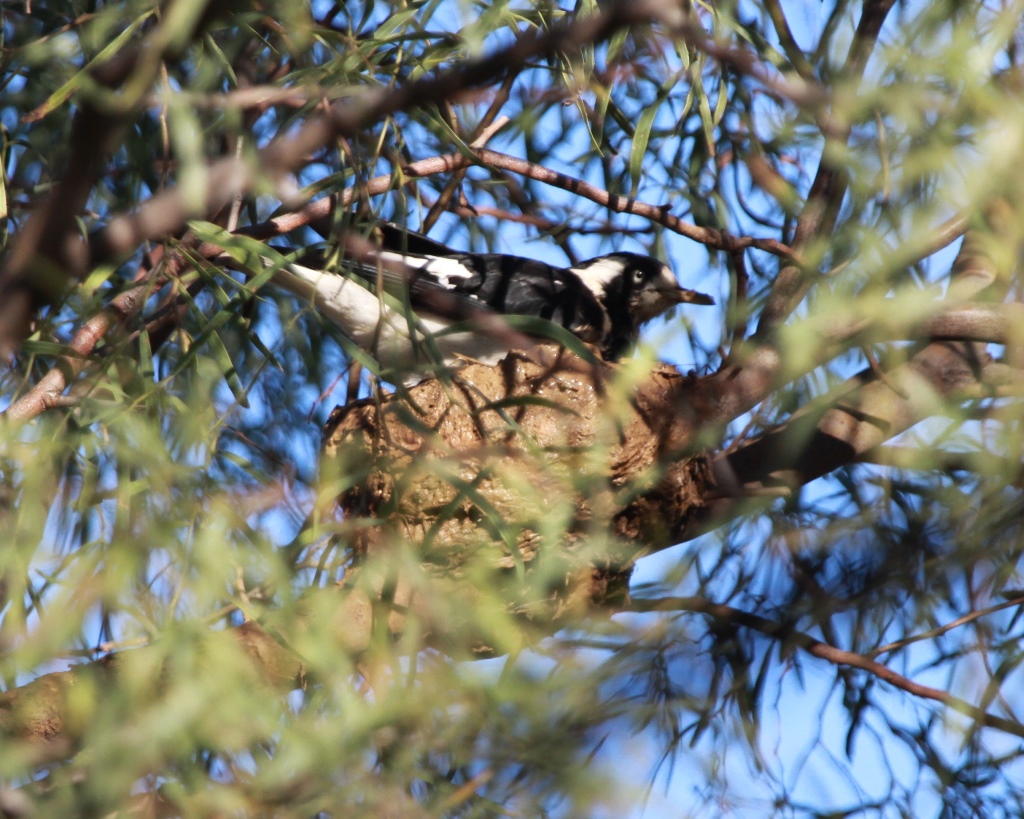
Lots of birds were singing, some common others not so.  Red Wattlebird is very common here, as is Crested Pigeon.  Magpielark is here all year round, and I have found quite a few of its mud bowl nests, though rarely with Mum in situ!


A common bird two kilometres (1 mile) away, but less common in the park is Sulphur-crested Cockatoo.  Australian Pelicans are often seen soaring over the park, so it was a nice surprise to see this one land and rest a while. 


I took a long shot of some ducks roosting, thinking they would be Pacific Black Ducks, but on closer inspection, I think they may be Freckled Duck, an irruptive species that I haven't seen here before.  It's always great to get a new bird on your local patch!

The "heron tree" had a Great Egret, but he flew to the middle of the wetlands before I got there.   Also on the tree was an Australian Darter, only the second I have recorded here in almost five years.


On the way back, a small group of Purple-crowned Lorikeets entertained, feeding busily on the Eucalyptus blossoms.