Showing posts with label Hooded Plover. Show all posts

Monday, February 15, 2021

Birdwatching in Robe

 Last weekend we had a short break in Robe.   I took the opportunity to do a little birdwatching.

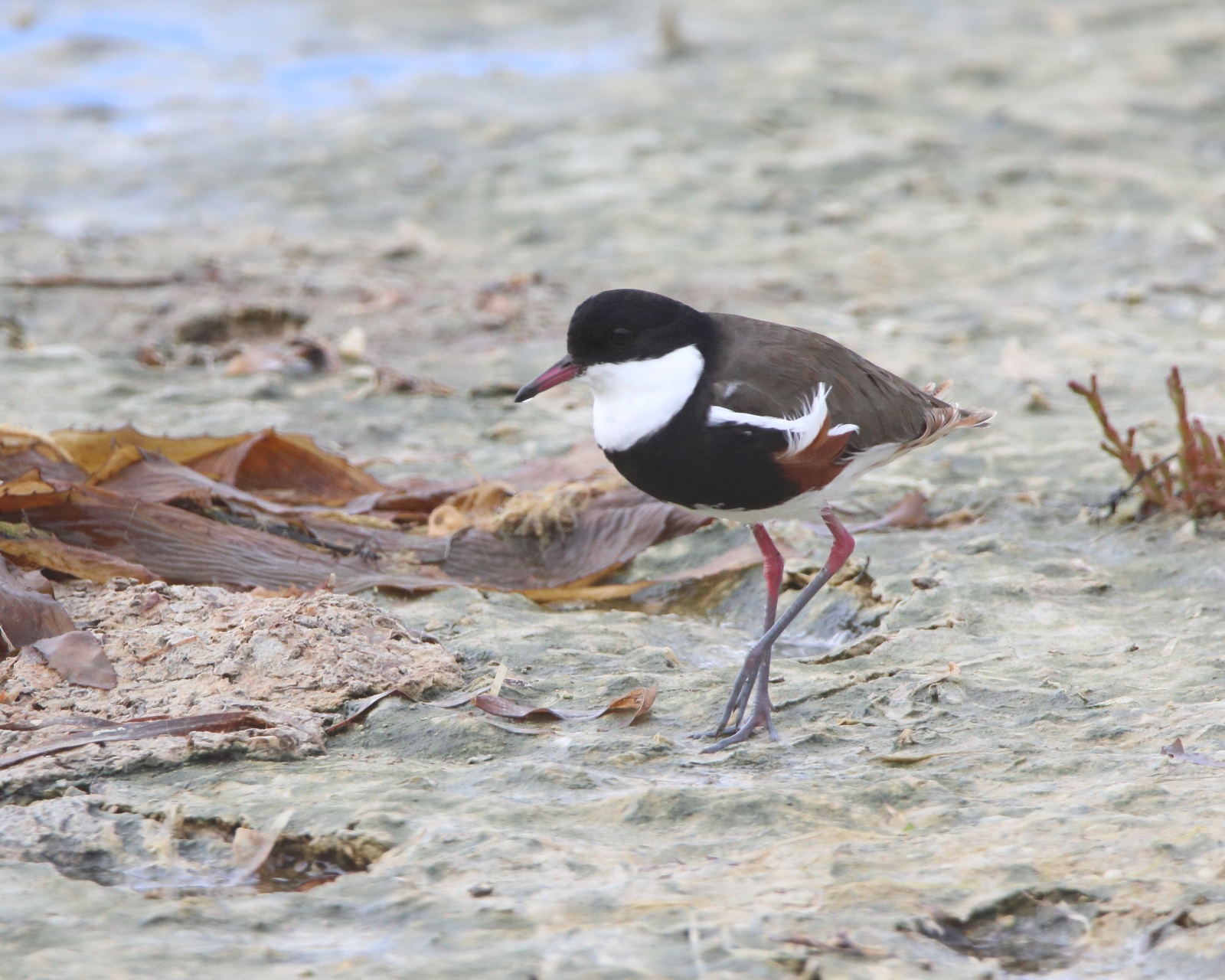
On Saturday morning i took a short walk through the dunes looking for a Rufous Bristlebird which had been seen here the previous day.  No luck, but as I walked down to West Beach I spotted a small plover feeding on the shoreline.  It was a Hooded Plover, a critically endangered rare breeding bird in SA.  It was unconcerned when I perched on a rock nearby and slowly came closer to give me some of the best photo's I've taken of this species.


I made a couple of trips to Fox Lake which has a very well designed hide.   Fox Lake is well known as a great spot to see the cryptically camouflaged Latham's Snipe. I scanned the mud flats and quickly picked out Red-kneed Dotterel and Black-fronted Dotterel. Both very common shorebirds in SA.  


Scanning again,  I picked out a Latham's Snipe partially hidden in the vegetation, then another, and another until i counted eight birds.  Unfortunately they are not as easy to photograph as a plover on the beach!


Saturday, February 1, 2020

Mount Gambier

Last weekend we headed down to Mount Gambier for the weekend.  On the way we stopped at Coonalpyn to see the grain silos which had been painted by a local artist."Silo Art" is growing in Australia and is seen as another way to attract visitors to small country towns.  This one depicts children that used to live in Coonalpyn


A little further on we stopped to see some tree carvings near Penola.  The carvings depict Mary MacKillop and her contemporaries.


Mount Gambier is famous for it's Blue Lake, a lake in an extinct volcanic crater

We also took a trip across the border to Portland in Victoria.  Portland was packed as there was a big fishing competition there.  We headed out to a couple of nearby beaches and found a couple of critically endangered Hooded Plovers.  This one has been flagged CV

Back in SA we headed to Carpenter Rocks where some of the crayfish fishing fleet were moored up.

Finally, on the way home, we called in to Millicent, where this statue honours those who died and fought in the Black Friday bush-fires. 


Tuesday, June 9, 2015

Weekend away

It's not often that we manage to get away for a long weekend. Last weekend we went to Port Victoria on the Yorke Peninsula.  With a population around 350, Port Victoria boasts a hotel, a general store and a kiosk/post office. In it's heyday, it was a thriving port for the bagged cereal trade, where bags of wheat and barley were manually loaded onto small boats at the jetty, before being transferred to ships anchored offshore. Being on the west coast of the peninsula it also has some beautiful sunsets.


I didn't have far to go to see some birds, with a pair of inquisitive Singing Honeyeaters coming close, closer, and sometimes too close.


There was also a regular Nankeen Kestrel hunting between us and the beach

On the boat ramp there were the usual pelicans and Silver Gulls, and on the local beach, Pacific Gulls and a single Hooded Plover.


Monday, April 1, 2013

Kangaroo Island - part 1

Maryann and I went to Kangaroo Island for Easter.  Kangaroo Island, locally known simply as KI is Australia's 3rd largest island, and is just a 45 minute ferry ride away from the mainland, across Backstairs Passage. 

Easter is a busy time on the island, and the ferry was completely full. However, there was room for a stowaway Welcome Swallow.


Our first stop was Antechamber Bay, one of KI's many beautiful sandy beaches. It is these beaches that makes KI a stronghold of Hooded Plover.  We saw a few during our stay including pairs of adults and some juveniles.


At Chapman River we saw a female Scarlet Robin, and the first of hundreds of Superb Fairywrens.


Our last stop before checking in to our accommodation was Cape Willoughby, home to Australia's first Lighthouse.

Each evening at 5pm in Kingscote, "John the Pelican Man" feeds the local pelicans (and Gulls!).   Obviously, the Pelicans have now got the routine as they start to gather from about 4:30.  They fly in from all points of the compass, some crashing down on the platform, and others landing on the water.  then its a stretch of the bill, ready for the days performance.


Invariably, John ends up with a Silver Gull on his head (hence the hat!). The Pelicans really know their part and gather round waiting for their fish, and all head into the water for the finale.


Kingscote is also a good spot for Cormorants, and it is possible to see all five Australian species here together.  This time we just saw Black-faced, and Pied, along with the ever present Pacific Gull.